# ServerKit Architecture
> Deep dive into how ServerKit connects domains, apps, containers, databases, and extensions.
> **Diagrams.** Each section leads with an image and keeps an ASCII fallback in a
> collapsible fold underneath. Images live in [`docs/images/architecture/`](images/architecture/);
> if you change one, update the ASCII block so the doc still reads in plain text.
---
## Table of Contents
- [System Overview](#system-overview)
- [Request Flow](#request-flow)
- [Backend Layers](#backend-layers)
- [Extension Platform](#extension-platform)
- [Template System](#template-system)
- [Port Allocation](#port-allocation)
- [Service Linking & Env Injection](#service-linking--env-injection)
- [Jobs & Scheduling](#jobs--scheduling)
- [Notifications Bus](#notifications-bus)
- [Agent Fleet](#agent-fleet)
- [Environment Pipeline](#environment-pipeline)
- [File Paths](#file-paths)
---
## System Overview

ASCII diagram
```
┌─────────────────────────────────────────────────────────────┐
│ INTERNET │
└─────────────────────────────────────────────────────────────┘
│
▼
┌─────────────────────────────────────────────────────────────────────────────────────────────────────┐
│ YOUR SERVER │
│ ┌───────────────────────────────────────────────────────────────────────────────────────────────┐ │
│ │ NGINX (Reverse Proxy) │ │
│ │ Port 80 / 443 │ │
│ │ │ │
│ │ ┌──────────────┐ ┌──────────────┐ ┌──────────────┐ ┌──────────────┐ │ │
│ │ │ app1.com │ │ app2.com │ │ api.app3.com │ │ Panel API │ │ │
│ │ │ :443 │ │ :443 │ │ :443 │ │ /api/v1/ │ │ │
│ │ └──────┬───────┘ └──────┬───────┘ └──────┬───────┘ └──────┬───────┘ │ │
│ └──────────┼───────────────────┼───────────────────┼───────────────────┼────────────────────────┘ │
│ │ │ │ │ │
│ │ proxy_pass │ proxy_pass │ proxy_pass │ proxy_pass │
│ ▼ ▼ ▼ ▼ │
│ ┌────────────────────────────────────────────────────────────┐ ┌─────────────────────────────┐ │
│ │ DOCKER CONTAINERS │ │ SERVERKIT PANEL │ │
│ │ │ │ Flask + Gunicorn (-w 1) │ │
│ │ ┌──────────┐ ┌──────────┐ ┌──────────┐ ┌──────────┐ │ │ │ │
│ │ │WordPress │ │ Flask │ │ Node.js │ │ Custom │ │ │ api/ services/ models/ │ │
│ │ │ :8001 │ │ :8002 │ │ :8003 │ │ :8004 │ │ │ jobs/ notifications/ │ │
│ │ │ │ │ │ │ │ │ │ │ │ plugins/ agent_gateway │ │
│ │ │ Apache │ │ Gunicorn │ │ PM2 │ │ Your │ │ │ │ │
│ │ │ PHP-FPM │ │ Python │ │ Express │ │ App │ │ │ Socket.IO (threading) │ │
│ │ └────┬─────┘ └──────────┘ └──────────┘ └──────────┘ │ └──────────────┬──────────────┘ │
│ └────────┼───────────────────────────────────────────────────┘ │ │
│ │ │ │
│ ▼ ▼ │
│ ┌────────────────────────────────────────────────┐ ┌──────────────────────────────────────┐ │
│ │ DATABASES │ │ PANEL STATE │ │
│ │ ┌────────┐ ┌──────────┐ ┌───────┐ ┌────────┐ │ │ SQLite (default) or PostgreSQL │ │
│ │ │ MySQL │ │Postgres │ │ Redis │ │Mongo │ │ │ Alembic migrations │ │
│ │ │ :3306 │ │ :5432 │ │ :6379 │ │ :27017 │ │ └──────────────────────────────────────┘ │
│ │ └────────┘ └──────────┘ └───────┘ └────────┘ │ │
│ └────────────────────────────────────────────────┘ │
│ │
└────────────────────────────────────────────────────────────────────────────────────────────────────┘
│
│ Socket.IO /agent namespace (HMAC) + HTTP long-poll
▼
┌──────────────────────────────────────────────┐
│ REMOTE SERVERS (managed fleet) │
│ serverkit-agent (Go) — separate repo │
└──────────────────────────────────────────────┘
```
The numbered zones in the diagram map to the rest of this document:
| # | Zone | Deep dive |
|---|---|---|
| 1 | **Clients** — admin users on the panel, public visitors on hosted sites | [Request Flow](#request-flow) |
| 2 | **Edge layer** — nginx terminating TLS, splitting panel traffic from public traffic | [Request Flow](#request-flow) |
| 3 | **ServerKit panel** — the Flask app and everything inside it | [Backend Layers](#backend-layers), [Extension Platform](#extension-platform), [Jobs](#jobs--scheduling), [Notifications](#notifications-bus) |
| 4 | **Runtime layer** — app containers, databases, panel state, on-disk paths | [Port Allocation](#port-allocation), [File Paths](#file-paths) |
| 5 | **Remote agent fleet** — Go agents on other servers | [Agent Fleet](#agent-fleet) |
Read as tiers rather than zones, that is:
1. **Frontend** — React 18 SPA (Vite + SCSS), built into Flask's static folder in production.
2. **Backend** — Flask REST API + Socket.IO managing Docker, nginx, databases, and system services.
3. **Agent** — a Go binary running on *remote* managed servers. Its source lives in the
separate [`serverkit-agent`](https://github.com/jhd3197/serverkit-agent) repo, **not**
in this one, so panel↔agent protocol changes are not atomic in a single commit.
Two flows cross the diagram in opposite directions: **control and management**
(panel → edge → containers, and panel → agents as outgoing commands) and
**public traffic / telemetry** (visitors → edge → containers, and agents →
panel as incoming heartbeat and metrics).
---
## Request Flow

ASCII diagram
```
User Request What Happens
─────────────────────────────────────────────────────────────────────────────────
Browser 1. DNS resolves app1.com to your server IP
│
▼
┌─────────┐ 2. Request hits Nginx on port 80/443
│ Nginx │ Nginx checks server_name directives
│ :80/443 │ Matches "app1.com" → proxy_pass http://127.0.0.1:8001
└────┬────┘
│
▼
┌─────────┐ 3. Nginx forwards request to Docker container
│ Docker │ Container receives request on internal port
│ :8001 │ App processes and returns response
└────┬────┘
│
▼
┌─────────┐ 4. Response flows back through Nginx
│ Response│ SSL termination handled by Nginx
│ 200 OK │ User sees the page
└─────────┘
```
Panel requests take the same path but terminate at Flask. Everything under
`/api/v1/` is JSON and auth-protected (JWT by default; a route accepts API keys
only by opting in through the shared policy decorator); the Flask 404 handler
serves `index.html` so client-side SPA routing works on deep links, while API
routes return typed JSON error envelopes carrying a request-correlation id,
shaped by one global handler (`app/exceptions.py`).
**Client IP.** Behind the bundled nginx, set `TRUST_PROXY_HEADERS=true` and
`TRUSTED_PROXY_HOPS=1` so Werkzeug's `ProxyFix` derives the real client IP;
leave it off for a directly-exposed dev server. All IP reads go through a single
`get_client_ip()` helper. See [SECURITY.md](../SECURITY.md).
---
## Backend Layers
The Flask app factory is `create_app()` in `backend/app/__init__.py`. Three layers:
| Layer | Path | Role |
|---|---|---|
| **API** | `app/api/` | Flask Blueprints, one file per feature. All routes under `/api/v1/`, guarded by the policy decorators in `app/middleware/rbac.py` (`auth_required()` / role checks — JWT-only is the default policy, API-key access is per-route opt-in; the caller's identity always resolves through `rbac.get_current_user()`). |
| **Services** | `app/services/` | Business logic. Stateless modules; all shell-outs, Docker API calls, and file writes live here. |
| **Models** | `app/models/` | SQLAlchemy ORM. Schema managed by Alembic migrations. Shared shapes live in mixins (`TimestampMixin`, `JsonColumnMixin`, `SoftDeleteMixin`, `SerializableMixin`, `RunLifecycleMixin`) and run/status fields use the canonical status vocabulary in `app/models/status.py`. |
Cross-cutting subsystems that sit beside those three:
- `app/jobs/` — background work and scheduling (see [Jobs & Scheduling](#jobs--scheduling))
- `app/notifications/` — the notification bus (see [Notifications Bus](#notifications-bus))
- `app/plugins/` + `app/plugins_sdk/` — the extension runtime and its SDK
- `app/sockets.py` — the Socket.IO channel registry (one declarative subscribe/unsubscribe door per channel) over a shared room grammar (`app/sockets_rooms.py`), plus the generalized run envelope (`run_log`/`run_status` events in `run__` rooms); two legacy raw log handlers remain, frozen by test until migrated
- `app/agent_gateway.py` — the `/agent` Socket.IO namespace for the remote fleet
- `app/middleware/security.py` — security headers
- `app/paths.py` — the single source of truth for on-disk locations
---
## Extension Platform
Most non-core functionality ships as an **extension**. The panel stays lean and
operators install only what they need.

ASCII diagram
```
┌───────────────────────────────────────────────────────────────────────────────┐
│ REGISTRY (serverkit-extensions repo) │
│ curated index.json — schema v2 │
│ SERVERKIT_REGISTRY_URL (unset → GitHub raw; set-but-empty → disabled) │
└───────────────────────────────┬───────────────────────────────────────────────┘
│ fetch (TTL 1h)
│ fallback: last-good cache → app/data/registry_index.json
▼
┌───────────────────────────────────────────────────────────────────────────────┐
│ MARKETPLACE (panel UI) │
│ preview → show permissions + sha256 → operator consents → install │
└───────────────────────────────┬───────────────────────────────────────────────┘
│ download zip, verify sha256 BEFORE extract
▼
┌───────────────────────┴───────────────────────┐
│ │
▼ (a) COPY-INSTALLED ▼ (b) FLAGSHIP / IN-PLACE
┌────────────────────────────────┐ ┌────────────────────────────────────┐
│ backend/** → app/plugins// │ │ builtin-extensions// │
│ frontend/** → src/plugins// │ │ loaded via importlib spec, │
│ │ │ NO file copy; seeded every boot │
└───────────────┬────────────────┘ └───────────────┬────────────────────┘
│ │
└─────────────────┬─────────────────────────┘
▼
┌──────────────────────────────┐
│ import app.plugins. │
│ register blueprint │
│ + models / jobs / sockets │
│ + before_request 503 guard │ ← makes disable take effect
└──────────────────────────────┘
```
### Manifest
Every extension ships a `plugin.json`. Required: `name` (slug), `display_name`,
`version`. Notable optional keys:
- `entry_point` — `"module:blueprint_attr"`, mounted at `url_prefix`
(default `/api/v1/`)
- `models`, `lifecycle` (`install`/`upgrade`/`uninstall` hooks)
- `jobs[]` and `schedules[]` — declaratively wired into the job system
- `permissions[]`, `config_schema`, `templates[]`
- `contributions{ nav, routes, tabs, command_palette, widgets, layouts, ai }`
The canonical spec is served live at `GET /api/v1/plugins/manifest-spec`.
### Two install classes
**(a) Flagship / in-place** — source stays in `builtin-extensions//` and is
imported directly via an `importlib` spec injected as `app.plugins.`. No
copy. Re-seeded on every boot; "uninstall" writes a marker so the seeder skips it.
**(b) Copy-installed** — the zip is extracted into `backend/app/plugins//`
and `frontend/src/plugins//`. This covers registry installs *and*
non-flagship bundled extensions.
> **Working on a copy-installed builtin?** Edit **both** the source in
> `builtin-extensions//` and the live copy under `app/plugins//`, or
> the next reinstall reverts you. Sync frontends with `sync-builtin-frontends.mjs`.
### In-repo extensions
Source lives in this repo under `builtin-extensions/`:
| Slug | Class | Notes |
|---|---|---|
| `serverkit-cloudflare-ops` | Flagship, in-place | Route-only, no sidebar entry |
| `serverkit-ftp` | Copy-installed builtin | Auto-installs on upgrade |
| `serverkit-cloud-provision` | Copy-installed builtin | Auto-installs on upgrade |
| `serverkit-remote-access` | Copy-installed builtin | Auto-installs on upgrade |
| `serverkit-status` | Copy-installed builtin | Auto-installs on upgrade |
| `serverkit-email` | Copy-installed builtin | Gated — auto-installs only if mail rows exist |
| `serverkit-git` | Marketplace one-click | Frontend-only, no backend |
| `serverkit-localkit` | Marketplace one-click | Backend-only, no frontend |
> `serverkit-wordpress` left the tree in plan 52 Phase 5: it is a standalone
> repo distributed through the registry (like `serverkit-k8s`/`serverkit-tramo`),
> offered during onboarding from the bundled registry index. Its database
> schema stays core forever — the **core data seam** (plan 52 D1, see
> EXTENSIONS.md "Data models & policy").
> **The security suite left core the same way** (plan 47 Ph3b-4 / plan 55
> Phase 3): `serverkit-clamav` (ClamAV+YARA scanning, quarantine),
> `serverkit-fail2ban` (management surface — status probing + the per-site
> jail write-half stay core on `Fail2banJailService`), `serverkit-lynis`,
> `serverkit-auto-updates`, and the headless `serverkit-image-scan`
> (CVE/SBOM; `image_vulnerability_scans`/`sbom_artifacts` stay core tables).
> Each mounts its routes back at the `/api/v1/security` prefix and
> contributes tabs into the Security tab group (`groupId="security"`), so an
> installed extension is indistinguishable from the pre-split page. The core
> Security page keeps only the zero-host-package baseline: overview,
> firewall, SSH keys, IP lists, integrity, audit, events, settings.
> Upgrade parity: `extension_migration.run_registry_auto_install()` installs
> each from the registry once when the matching host tool is present.
### Standalone extension repos
These have their own repos and install from the registry as versioned,
sha256-pinned zips (`bundled: false`):
| Extension | Repo |
|---|---|
| Analytics | [jhd3197/serverkit-analytics](https://github.com/jhd3197/serverkit-analytics) |
| Automations (tramo) | [jhd3197/serverkit-tramo](https://github.com/jhd3197/serverkit-tramo) |
| CrowdSec | [jhd3197/serverkit-crowdsec](https://github.com/jhd3197/serverkit-crowdsec) |
| DNS Server | [jhd3197/serverkit-dns-server](https://github.com/jhd3197/serverkit-dns-server) |
| Faro | [jhd3197/serverkit-faro](https://github.com/jhd3197/serverkit-faro) |
| GPU Monitor | [jhd3197/serverkit-gpu](https://github.com/jhd3197/serverkit-gpu) |
| Agent GUI (beta) | [jhd3197/serverkit-gui](https://github.com/jhd3197/serverkit-gui) |
| Kubernetes | [jhd3197/serverkit-k8s](https://github.com/jhd3197/serverkit-k8s) |
| Mail Server | [jhd3197/serverkit-mail](https://github.com/jhd3197/serverkit-mail) |
Supporting repos:
| Repo | Role |
|---|---|
| [jhd3197/serverkit-extensions](https://github.com/jhd3197/serverkit-extensions) | The curated registry `index.json` |
| [jhd3197/serverkit-agent](https://github.com/jhd3197/serverkit-agent) | The Go fleet agent |
| [jhd3197/Tramo](https://github.com/jhd3197/Tramo) | The automation engine the Automations extension embeds |
> **Retired.** The old drag-and-drop **Workflow Builder** (`serverkit-workflows`)
> no longer exists. It was replaced by the **Automations** extension, which runs
> workflows in a managed tramo container rather than parsing a graph in-panel;
> the panel proxies runs, approvals, and inbound webhooks. `/workflow` redirects
> to `/automations`, and the retired slug is swept on upgrade.
### Permissions
Declared in `plugin.json`, enforced by `plugins_sdk.permissions.require(slug, cap)`.
Known capabilities: `docker`, `filesystem`, `shell`, `network`, `db`, plus
namespaced `agent.command:`. Unknown strings are surfaced in the consent UI.
**This is a consent gate, not a sandbox.** An extension that imports a host
module directly bypasses it. The security posture is: curated registry +
sha256 pinning + install-time consent + auditable source — *not* isolation.
### SDK
Backend (`app.plugins_sdk`): `db`, JWT helpers, `current_user()`, `logger`,
`audit`, `config(slug)`, plus `ai`, `permissions`, `sockets`, `queue`, `notify`,
and `jobs` façades.
Frontend (`frontend/src/plugins/sdk`): versioned (`SDK_VERSION`), pinned by each
extension's `sdk_version`. Exports `api`, design-system primitives (`KpiBand`,
`MetricCard`, `DataTable`, `ResourceList`, `Drawer`, `PageTopbar`, …), hooks
(`useToast`, `useAuth`, `useTheme`, `useServerkitAI`), and router helpers.
> **AI is core, not an extension.** The assistant lives in `app/services/ai_service.py`
> + `app/api/ai.py` + `contexts/AIContext.jsx`. Extensions *extend* it by
> registering tools and context through `plugins_sdk.ai` and the manifest's
> `contributions.ai`.
---
## Template System

ASCII diagram
```
┌──────────────────────────────┐ ┌──────────────────────────────┐
│ SHIPPED CATALOG (in repo) │ │ OPERATOR TEMPLATES │
│ backend/templates/*.yaml │ │ /etc/serverkit/templates/ │
│ 100+ templates │ │ installer-populated + local │
└──────────────┬───────────────┘ └──────────────┬───────────────┘
│ │
└──────────────────┬────────────────────┘
▼
┌────────────────────────┐
│ TemplateService │
│ merges both dirs │
└───────────┬────────────┘
│
┌───────────────┴───────────────┐
▼ ▼
┌─────────────────┐ ┌──────────────────┐
│ kind: compose │ │ kind: repo │
│ docker-compose │ │ build from git │
└────────┬────────┘ └────────┬─────────┘
└──────────────┬───────────────┘
▼
┌─────────────────────────┐
│ allocate port │
│ render compose │
│ create app + nginx │
│ vhost + optional SSL │
└─────────────────────────┘
```
`TemplateService` reads from **two** directories and merges them: the shipped
catalog in `backend/templates/` (the source of truth, 100+ YAML files) and the
operator-writable `/etc/serverkit/templates/` that the installer populates.
Two template kinds: `kind: compose` (the vast majority — a rendered
docker-compose stack) and `kind: repo` (build from a git repository). Schema
reference: [TEMPLATE_CATALOG_SCHEMA.md](TEMPLATE_CATALOG_SCHEMA.md).
---
## Port Allocation
`TemplateService._find_available_port()` resolves the starting port in priority order:
1. The global `managed_app_base_port` setting, when set to a non-zero value
2. The template's own `default` port
3. `8000` as the fallback
From there it scans upward, skipping any port that is already assigned in the
panel database, already published by a Docker container, or fails a live
`bind()` test on `127.0.0.1`. Ports below 1024 are always skipped. If no port is
found within the attempt budget, it falls back to a random high port.
---
## Service Linking & Env Injection
There is **no** fixed set of injected variable names. Database env var names are
chosen by the template or manifest author, because they have to match what the
image actually expects — `wordpress.yaml` emits `WORDPRESS_DB_HOST` /
`WORDPRESS_DB_USER`, a Postgres stack emits `POSTGRES_*`, and so on.
What ServerKit provides is **reference resolution at injection time**
(`env_reference_service.py`). A manifest declares a reference and ServerKit
resolves it when the container starts:
- `fromSecret` — pull the value out of a vault entry
- `fromService` — pull a field off a linked service: `connectionString`, `host`,
`port`, `database`, `username`, `password`
```yaml
environment:
MY_APP_DB_URL:
fromService: { name: app-postgres, field: connectionString }
MY_APP_API_KEY:
fromSecret: { vault: prod, key: stripe_api_key }
```
So the *value* is managed by ServerKit; the *name* is yours. See
[SERVERKIT_YAML.md](SERVERKIT_YAML.md).
---
## Jobs & Scheduling
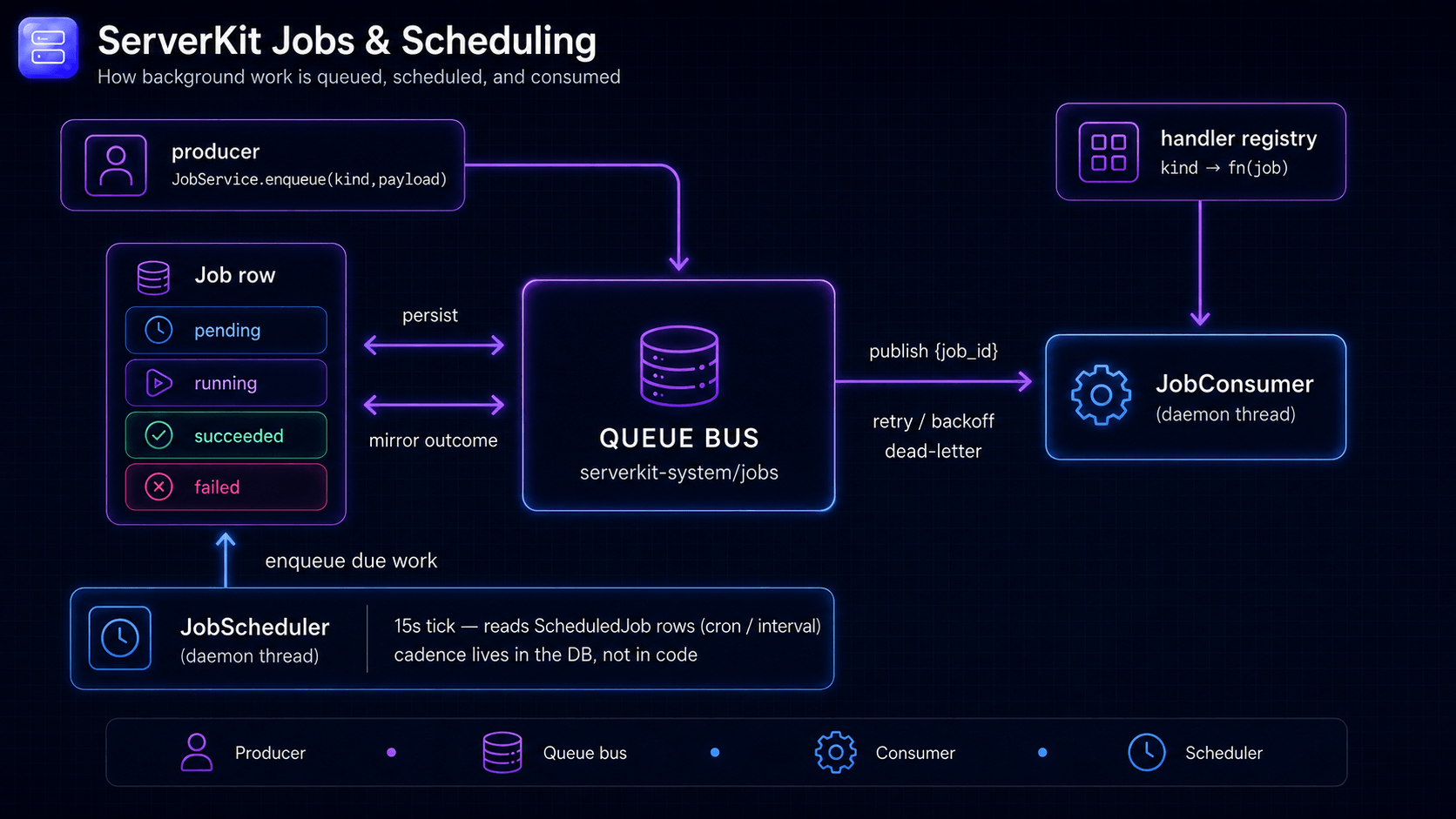
ASCII diagram
```
producer handler registry
│ ┌───────────────┐
│ JobService.enqueue(kind, payload) │ kind → fn(job)│
▼ └───────┬───────┘
┌──────────┐ persist ┌──────────────┐ publish {job_id} │
│ Job row │◀────────────▶│ QUEUE BUS │────────────────────┐ │
│ pending │ mirror │ serverkit- │ │ │
│ running │ outcome │ system/jobs │ retry / backoff │ │
│ succeeded│ └──────────────┘ dead-letter ▼ ▼
│ failed │ ┌──────────────────────┐
└──────────┘ │ JobConsumer │
│ (daemon thread) │
▲ └──────────────────────┘
│ enqueue due work
┌──────────────────┐
│ JobScheduler │ 15s tick — reads ScheduledJob rows (cron / interval)
│ (daemon thread) │ cadence lives in the DB, not in code
└──────────────────┘
```
All background work funnels through one abstraction. A producer calls
`JobService.enqueue(kind, payload)`, which persists a `Job` row
(`pending → running → succeeded | failed | cancelled`, with `attempts`,
`priority`, `owner_type`/`owner_id`, `correlation_id`) and publishes a thin
`{'job_id': ...}` message onto the Queue Bus. Retry, backoff, and dead-lettering
are inherited from the bus; the Job row mirrors the outcome so there is a single
place to observe every background operation.
A single `JobConsumer` daemon thread polls and dispatches by `kind` through an
in-process handler registry. A single `JobScheduler` (15s tick) replaced the old
per-domain `while True: sleep` threads — it enqueues a Job for every due
`ScheduledJob` row, so adding or pausing periodic work is a database change, not
a code change.
Extensions plug in via `jobs.register(kind, handler)` / `jobs.enqueue()` /
`jobs.schedule()`, or declaratively through the manifest's `jobs[]` and
`schedules[]` blocks — which are paused and resumed alongside the extension
itself. The whole system is a no-op under the testing config so the suite can
drive handlers directly.
> Don't force real-time streams (live metrics, log tailing, terminal) into jobs —
> those belong on Socket.IO.
---
## Deploy Console & run logs
Every install and deploy is a `DeploymentJob` run by the single `JobConsumer`, and
its live output is surfaced by the full-page **Deploy Console** at
`/deployments/`. All deploy-path logging funnels through one seam,
`app/services/run_log_service.py` (`RunLogStream`):
- **Batched persistence** — one DB commit + one socket emit per flush (50 lines,
300 ms, a step change, or close) instead of a commit per line; a hard 5000-row cap
per job. Every line is a `DeploymentJobLog` row.
- **Truthful failure tail** — an 80-line in-memory ring buffer persisted to the job's
`result` JSON on failure, alongside `step_timings` and a matched plain-language
`hint` (no schema migration).
- **Clean text** — ANSI escapes and `\r` progress overwrites are stripped at the seam;
builds run with `--ansi never --progress plain` (`DockerService.compose_up_streaming`).
- **Crash-proof** — `RunLogStream.log()` never raises; a flush failure degrades to a
buffered-drop + one telemetry event. Job failure marking never depends on the log
path.
The read side stays the source of truth: `GET /deployment-jobs//logs?after_id=`
for incremental polling, plus the run envelope's `run_log` / `run_status`
Socket.IO events (room `run_deploy_`) as an accelerator — the legacy
`deploy_log` / `deploy_status` pair (room `deploy_{job_id}`) is still dual-emitted
for compatibility until the Deploy Console migrates. The generic frontend hook is
`useServerStream`; the deploy-specific `useDeployJobStream` hook de-dupes by row
id and re-syncs with `after_id` on reconnect, with a 2-second poll fallback — so
the console works with sockets disabled. Emits are in-process only,
consistent with the single-worker gateway constraint below. See
[DEPLOY_CONSOLE.md](DEPLOY_CONSOLE.md).
---
## Notifications Bus

ASCII diagram
```
notify.send('backup.completed', to='admins', data={...}) ← non-blocking
│
▼
┌──────────────────────────────────────────┐
│ Notification + NotificationDelivery │ one delivery per (recipient × channel)
└──────────────────┬───────────────────────┘
│ publish
▼
┌──────────────────────────┐
│ QUEUE BUS │ serverkit-system/notifications
│ retry / backoff / DLQ │
└────────────┬─────────────┘
▼
┌──────────────────────────┐ ┌────────────────────────┐
│ NotificationConsumer │───────▶│ CATALOG │
│ (daemon thread) │ │ event_key → title, │
│ render → dispatch │ │ template, severity, │
└────────────┬─────────────┘ │ preference category │
│ └────────────────────────┘
┌───────────────┼───────────────┬───────────────┬──────────────┐
▼ ▼ ▼ ▼ ▼
┌────────┐ ┌──────────┐ ┌──────────┐ ┌──────────┐ ┌──────────┐
│ inapp │ │ email │ │ discord │ │ telegram │ │ webhook │ + slack
└────────┘ └──────────┘ └──────────┘ └──────────┘ └──────────┘
digestable / quiet-hours deliveries ──▶ status: queued_digest (never enqueued)
│
▼ hourly ScheduledJob
one grouped, branded email → sent
```
`notify.send(event, to, data)` is non-blocking: it writes a durable
`Notification` plus one `NotificationDelivery` per (recipient × channel),
enqueues them, and returns. A background consumer renders each delivery and
hands it to the matching channel adapter.
Channels are a pluggable key→adapter registry (`inapp`, `email`, `discord`,
`slack`, `telegram`, `webhook`); `register_adapter()` lets an extension add SMS
or web-push and have it delivered exactly like a core channel. The **catalog**
maps each `event_key` to its presentation defaults — title, template, severity,
and preference category (`system` | `security` | `backups` | `apps`) — and
`catalog.register()` lets a plugin event render through the identical pipeline.
**Digests** are the per-user cadence layer. Digestable deliveries and
quiet-hours catch-ups are parked at `queued_digest` and never enqueued; an
hourly scheduled job groups a user's held rows into one branded email. Cadence
is `off` | `daily` | `weekly` per user. Contract:
[NOTIFICATIONS_CONTRACT.md](NOTIFICATIONS_CONTRACT.md).
---
## Agent Fleet

ASCII diagram
```
┌──────────────────────────────────────────────────────────────────┐
│ SERVERKIT PANEL │
│ │
│ app/agent_gateway.py app/api/agent_poll.py │
│ Socket.IO /agent namespace HTTP long-poll fallback │
│ │ │ │
│ └──────────────┬───────────────────┘ │
│ ▼ │
│ ┌──────────────────────────────┐ │
│ │ agent_registry (in-memory) │ ⚠ SINGLE PROCESS │
│ │ live agents, socket↔server │ │
│ │ index, session tokens, │ │
│ │ in-flight command queues │ │
│ └──────────────────────────────┘ │
└─────────────────────────────┬────────────────────────────────────┘
│ HMAC auth, heartbeat + metrics, command routing
┌───────────────────┼───────────────────┐
▼ ▼ ▼
┌────────────┐ ┌────────────┐ ┌────────────┐
│ server A │ │ server B │ │ server C │
│ Go agent │ │ Go agent │ │ Go agent │
└────────────┘ └────────────┘ └────────────┘
```
The panel manages remote servers through a fleet of Go agents. The agent binary
is maintained in the separate
[`serverkit-agent`](https://github.com/jhd3197/serverkit-agent) repo — agent-side
capability changes ship there, so panel↔agent protocol changes are **not** atomic
in one commit. Coordinate with [FLEET_CONTRACT.md](FLEET_CONTRACT.md).
Agents connect over the Socket.IO `/agent` namespace (HMAC-authenticated,
heartbeat + metrics + command routing), with an HTTP long-poll fallback for
networks where WebSocket is blocked.
> ### ⚠️ Deployment constraint — single WebSocket worker
>
> The agent gateway keeps **all** connected-agent state — the live-agent
> registry, the socket↔server index, session tokens, and in-flight command
> queues — **in memory in one process**.
>
> Run the panel with a **single** gunicorn worker using a plain threaded worker:
> `-w 1 --threads N`. WebSocket is served by simple-websocket to match
> `async_mode='threading'`; the **gevent-websocket worker class double-answers
> the WS handshake and breaks WebSocket**.
>
> Scaling to multiple workers without a shared backplane (e.g. a Redis message
> queue) will silently misroute or drop commands for agents connected to a
> different worker. See [HORIZONTAL_SCALING_SPEC.md](HORIZONTAL_SCALING_SPEC.md)
> and [SECURITY.md](../SECURITY.md).
---
## Environment Pipeline
Dev/staging/production workflows for managed WordPress sites.

ASCII diagram
```
┌──────────────┐ promotion ┌──────────────┐ promotion ┌──────────────┐
│ DEV │───────────▶│ STAGING │───────────▶│ PRODUCTION │
│ (Standalone) │ │ (Standalone) │ │ (Production) │
└──────┬───────┘ └──────┬───────┘ └──────┬───────┘
│ │ │
└─────────── sync ──────────┴─────────── sync ──────────┘
```
- **Promotion** — push code (git) and/or database from a lower environment to a
higher one: `promote_code`, `promote_database`, `promote_full`.
- **Syncing** — `sync_from_production` pulls the latest production database and
media down to dev/staging for testing.
- **Sanitization** — sensitive user data is stripped automatically during sync.
The engine is `environment_pipeline_service.py` in core, driven by a job handler;
the HTTP routes live in the **serverkit-wordpress** extension. Details:
[MULTI_ENVIRONMENT.md](MULTI_ENVIRONMENT.md).
---
## File Paths
Every path below is defined in `backend/app/paths.py` and each is overridable by
the matching environment variable — the values shown are the production defaults.
```
/var/serverkit/ # SERVERKIT_DIR — data root
├── apps/ # deployed applications
└── deployments/ # deployment working dirs
/etc/serverkit/ # SERVERKIT_CONFIG_DIR
├── templates/ # operator template library (YAML)
├── email/ # mail server config
├── install-state.json # written by the installer
└── ssl-mode # nginx SSL mode flag
/var/backups/serverkit/ # SERVERKIT_BACKUP_DIR
├── databases/
├── wordpress/
└── snapshots/
/var/log/serverkit/ # SERVERKIT_LOG_DIR
└── builds/ # build logs
/var/cache/serverkit/ # SERVERKIT_CACHE_DIR
├── builds/
└── wp-plugins/
/var/quarantine/ # SERVERKIT_QUARANTINE_DIR
/var/vmail/ # VMAIL_DIR — mail storage
/nginx/ssl/ # nginx TLS material
```
Notes:
- **The panel has no `config.yaml`.** Panel configuration is `backend/config.py`
plus environment variables / `.env`. The only `config.yaml` in the ecosystem
belongs to the *agent*, at `/etc/serverkit-agent/config.yaml`.
- Backups live under `/var/backups/serverkit`, **not** under `/var/serverkit/`.
- Always import from `app.paths` rather than hardcoding — the env overrides are
what let the test suite and local dev run off-root.
---
## Troubleshooting
See the [Deployment Guide](DEPLOYMENT.md) for 502 errors, container failures, and
networking issues.
---
## See Also
- [Installation Guide](INSTALLATION.md)
- [Local Development](LOCAL_DEVELOPMENT.md)
- [API Reference](API.md)
- [Deployment Guide](DEPLOYMENT.md)
- [Extensions](EXTENSIONS.md) · [Registry](EXTENSIONS_REGISTRY.md)
- [Fleet Contract](FLEET_CONTRACT.md)
- [serverkit.yaml Reference](SERVERKIT_YAML.md)