 IvanHunters
01d68904ea
Replace the group-based authorization model on the Phase-1 Grafana
OIDC selector with an app-side users map, mirroring the tenant
kube-apiserver sibling in cozystack/cozystack#3044.

What is removed
- The three chart-owned KeycloakRealmGroup objects in the cozy realm
  (`<clientId>-{admin,editor,viewer}`). A Helm release must not own
  directory objects — toggling `spec.oidc.mode: System -> None` or
  deleting the Monitoring release would Helm-delete the groups, and
  with them any membership curated out-of-band. Per-instance groups
  in the platform realm is exactly the design question left open at
  the end of cozystack/community#24; establishing it as precedent
  from a monitoring PR is out of scope.
- Dash-separated group naming (`<namespace>-<release>-<role>`) was
  also collision-prone against tenant/subtenant paths, since both
  the namespace and release names can themselves contain dashes.
- `role_attribute_path` in the Grafana `generic_oauth` block and the
  default-Viewer fallback, which handed org-Viewer to every cozy
  realm identity that logged in — cross-tenant metrics read across
  every opted-in Grafana. Also removed the `groups` client scope
  from the KeycloakClient defaults.
- `monitoring.oidc.allowAssignGrafanaAdmin` helper and the internal
  `oidc.grafanaAdmin` values key: the feature was already deferred
  and the helper's release-name-only guard was tenant-spoofable.

What replaces it
- `spec.oidc.users: [{email, role: Admin|Editor|Viewer}]` on the
  Monitoring chart values.
- A chart-owned post-install/post-upgrade Job
  (`templates/grafana/oidc-users-job.yaml`) that reconciles that
  list into Grafana's Main Org. via the admin API: pre-provisions
  a local Grafana account per listed email so the reconcile can
  set the org role before the operator's first OIDC login, adds
  the account to the org, PATCHes the role to converge across
  re-runs, and prunes every non-admin Main-Org member whose email
  is not in the list (handles both entry removal and `mode: None`).
- `skip_org_role_sync = true` + `oauth_allow_insecure_email_lookup
  = true` in the generic_oauth block. The former stops a login from
  overwriting the Job's assignments; the latter binds the OIDC
  identity to the pre-provisioned local account.
- Job talks to Grafana over the in-cluster Service and reads
  admin creds from the chart-managed `grafana-admin-password`
  Secret via `envFrom`: no ServiceAccount / Role / RoleBinding.
  `activeDeadlineSeconds: 900` caps a stuck Job so a broken Grafana
  cannot hold the release in `pending-upgrade`.

Defensive rendering
- `.Values.oidc | default dict` in the four templates that dereference
  the `oidc` block so `oidc: ~` or an omitted block no longer nil-derefs.
- `oidc-client-secret.yaml` falls back to a fresh random when the
  existing Secret lookup succeeds but `data.client-secret` is empty.

Rationale: cozystack/cozystack#3176 review from @lllamnyp
(architectural CHANGES_REQUESTED points 1, 2, 3 + the default-Viewer
leak). The three points stack: dropping the groups incidentally
fixes the naming-collision and the default-Viewer leak, and the
users-Job gives operators the same UX story as the tenant
kube-apiserver PR across both sides of the platform.

Signed-off-by: IvanHunters <xorokhotnikov@gmail.com>


Cozystack
Cozystack is a free platform and framework for building clouds.
Cozystack is a CNCF Sandbox Level Project that was originally built and sponsored by Ænix.
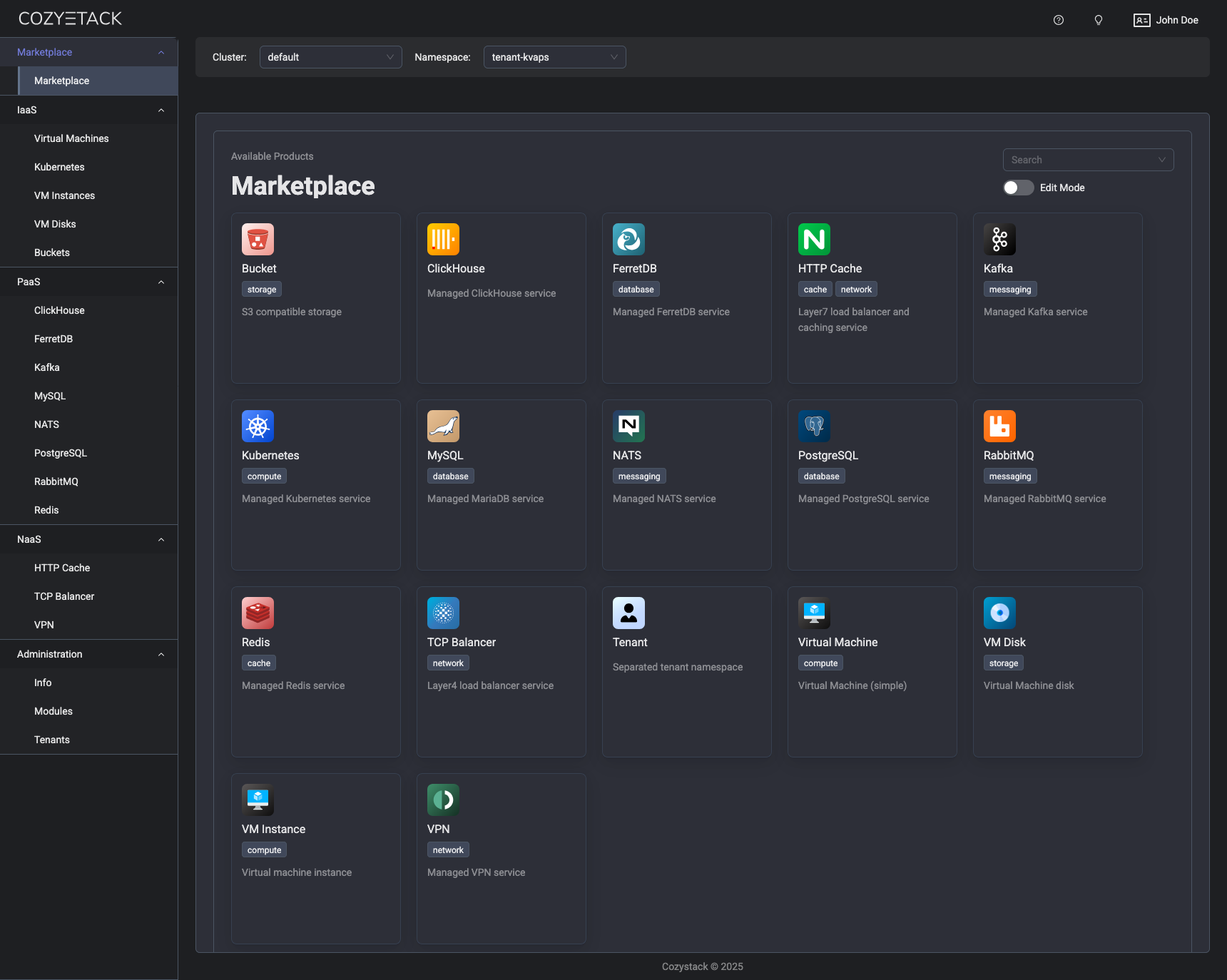
With Cozystack, you can transform a bunch of servers into an intelligent system with a simple REST API for spawning Kubernetes clusters, Database-as-a-Service, virtual machines, load balancers, HTTP caching services, and other services with ease.
Use Cozystack to build your own cloud or provide a cost-effective development environment.
Use-Cases
-
Using Cozystack to build a public cloud
You can use Cozystack as a backend for a public cloud -
Using Cozystack to build a private cloud
You can use Cozystack as a platform to build a private cloud powered by Infrastructure-as-Code approach -
Using Cozystack as a Kubernetes distribution
You can use Cozystack as a Kubernetes distribution for Bare Metal
Documentation
The documentation is located on the cozystack.io website.
Read the Getting Started section for a quick start.
If you encounter any difficulties, start with the troubleshooting guide and work your way through the process that we've outlined.
Versioning
Versioning adheres to the Semantic Versioning principles.
A full list of the available releases is available in the GitHub repository's Release section.
Contributions
Contributions are highly appreciated and very welcomed!
In case of bugs, please check if the issue has already been opened by checking the GitHub Issues section. If it isn't, you can open a new one. A detailed report will help us replicate it, assess it, and work on a fix.
You can express your intention to on the fix on your own. Commits are used to generate the changelog, and their author will be referenced in it.
If you have a concrete feature request, open an issue. For a cross-cutting or architectural change, open a design proposal in the community repo. For questions or early ideas, use GitHub Discussions. See CONTRIBUTING.md for the full routing.
Community
You are welcome to join our Telegram group and come to our weekly community meetings. Add them to your Google Calendar or iCal for convenience.
License
Cozystack is licensed under Apache 2.0.
The code is provided as-is with no warranties.
Commercial Support
A list of companies providing commercial support for this project can be found on official site.