 Ivan Okhotnikov
8541a95cb7
The legacy path used genCA/genSignedCert inside a Helm template. Those
functions are not idempotent across renders — every Flux HelmRelease
reconcile produces a fresh CA + cert. The deployment's
checksum/tls-secret podAnnotation is a sha256 of that ever-changing
template, so each reconcile flips the PodTemplate and materialises a
new ReplicaSet. Under load — e.g. the E2E install phase where
cert-manager / CDI / LINSTOR cascade races cause repeated VPA HR
reconciles — the churn produces 10+ admission-controller ReplicaSets
in minutes and blocks the entire cozystack-platform HR because VPA
never converges to Ready.

Replace the source of the TLS Secret with a cert-manager Certificate
plus a namespace-scoped selfSigned Issuer, gated on a new
`admissionController.tls.certManagerEnabled` value that defaults to
`true`. cert-manager only writes the Secret when the certificate is
close to expiry (renewBefore), so reconcile-driven churn stops.

  * New charts/vertical-pod-autoscaler/templates/admission-controller/
    certificate.yaml renders the Issuer and the Certificate. The
    Certificate spec exactly mirrors the legacy genSignedCert shape —
    single DNS SAN `vpa-webhook.<ns>.svc`, 365d validity — so the
    admission-controller sees the same certificate topology it always
    saw. The Secret name resolves via the existing
    `admissionController.tls.secretName` helper, which means
    cert-manager writes into the same Secret the legacy template used
    to own (`<release>-admission-controller-tls`); a separate
    pre-upgrade hook (next commit) strips Helm/Flux ownership from
    that existing Secret on upgrade so cert-manager can adopt it
    without racing Helm's garbage collector.

  * The legacy Secret template stays in the chart, wrapped in an
    additional `{{- if not .certManagerEnabled }}` guard, so
    operators who explicitly opt out keep the old behaviour.

  * The deployment's `checksum/tls-secret` podAnnotation is gated
    behind the same flag. Under cert-manager it would either be
    misleading (Secret content is not driven by that template
    anymore) or trigger a pointless rollout on every unrelated chart
    change; both worse than not emitting it.

The `existingSecret` path is untouched — operators supplying an
external TLS Secret continue to bypass both cert-manager and the
legacy Secret template.

Verified by `helm template`:
  - certManagerEnabled=true (default): Certificate+Issuer rendered,
    no legacy Secret, no checksum/tls-secret annotation.
  - certManagerEnabled=false: legacy Secret rendered, no Certificate,
    checksum/tls-secret annotation restored.
  - existingSecret=<name>: neither path renders, deployment mounts
    the external Secret.

Signed-off-by: Ivan Okhotnikov <ivan.okhotnikov@aenix.io>


Cozystack
Cozystack is a free platform and framework for building clouds.
Cozystack is a CNCF Sandbox Level Project that was originally built and sponsored by Ænix.
With Cozystack, you can transform a bunch of servers into an intelligent system with a simple REST API for spawning Kubernetes clusters, Database-as-a-Service, virtual machines, load balancers, HTTP caching services, and other services with ease.
Use Cozystack to build your own cloud or provide a cost-effective development environment.
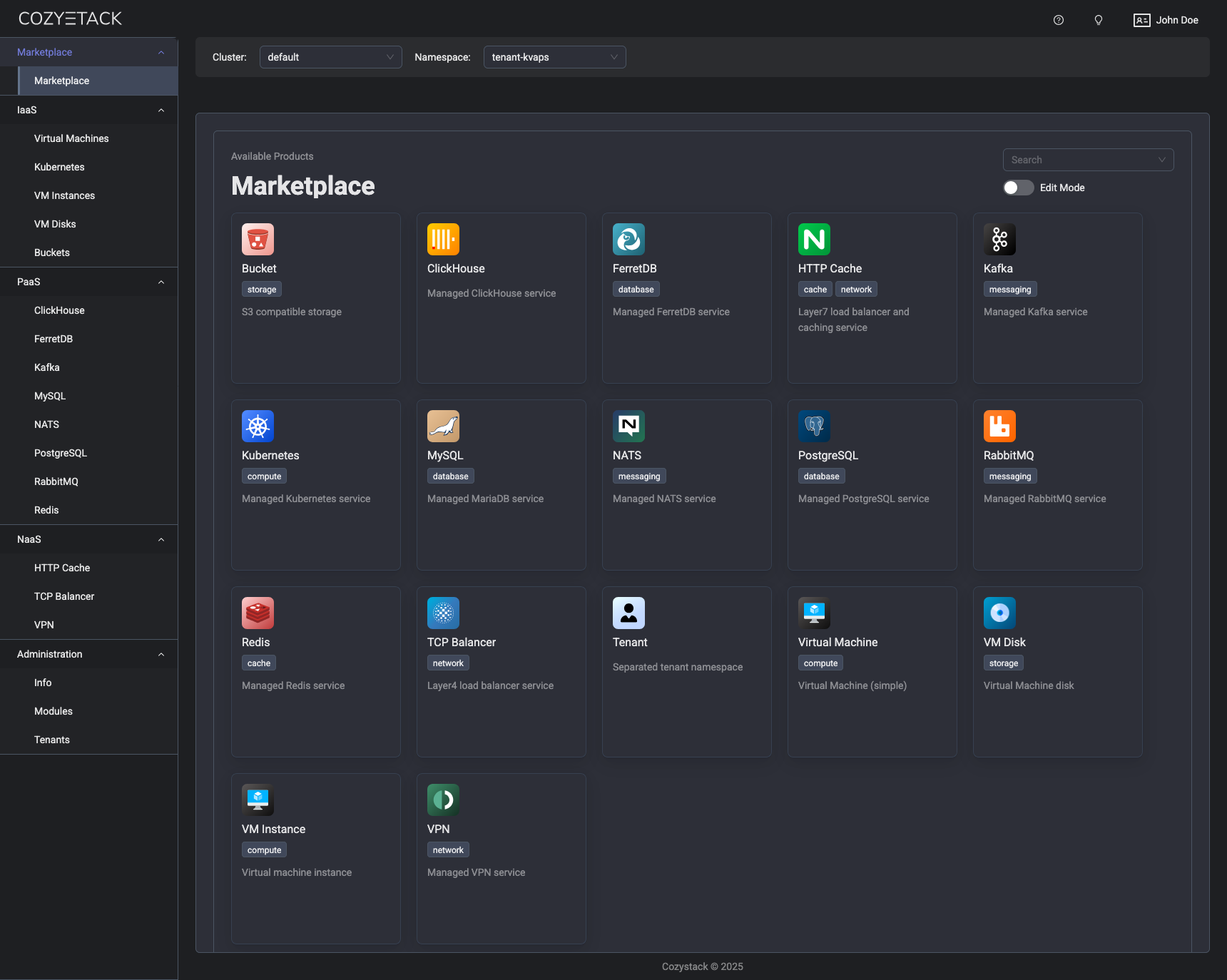
Use-Cases
-
Using Cozystack to build a public cloud
You can use Cozystack as a backend for a public cloud -
Using Cozystack to build a private cloud
You can use Cozystack as a platform to build a private cloud powered by Infrastructure-as-Code approach -
Using Cozystack as a Kubernetes distribution
You can use Cozystack as a Kubernetes distribution for Bare Metal
Documentation
The documentation is located on the cozystack.io website.
Read the Getting Started section for a quick start.
If you encounter any difficulties, start with the troubleshooting guide and work your way through the process that we've outlined.
Versioning
Versioning adheres to the Semantic Versioning principles.
A full list of the available releases is available in the GitHub repository's Release section.
Contributions
Contributions are highly appreciated and very welcomed!
In case of bugs, please check if the issue has already been opened by checking the GitHub Issues section. If it isn't, you can open a new one. A detailed report will help us replicate it, assess it, and work on a fix.
You can express your intention to on the fix on your own. Commits are used to generate the changelog, and their author will be referenced in it.
If you have a concrete feature request, open an issue. For a cross-cutting or architectural change, open a design proposal in the community repo. For questions or early ideas, use GitHub Discussions. See CONTRIBUTING.md for the full routing.
Community
You are welcome to join our Telegram group and come to our weekly community meetings. Add them to your Google Calendar or iCal for convenience.
License
Cozystack is licensed under Apache 2.0.
The code is provided as-is with no warranties.
Commercial Support
A list of companies providing commercial support for this project can be found on official site.