 Ivan Okhotnikov
cb04caecee
The extra/monitoring chart enforces `.Release.Name == "monitoring"`
in templates/check-release-name.yaml (the tenant Monitoring is a
per-namespace singleton). Naming the Monitoring CR anything else
makes the operator materialise an outer HelmRelease with that name
and the chart hard-fails at render with

  execution error at (monitoring/templates/check-release-name.yaml:2:4):
    The name of the release MUST BE monitoring

Rename the CR to `monitoring` in both files. Rework every derived
name to match the actual reality of the chart pipeline instead of
the invented `monitoring-<TEST_NAME>` prefix the tests polled for:

  * outer HR  = ${CR_NAME}                        = monitoring
  * inner HR  = ${CR_NAME}-system                 = monitoring-system
    (rendered by extra/monitoring/templates/helmrelease.yaml as
     `metadata.name: {{ .Release.Name }}-system`)
  * clientId  = ${namespace}-${inner Release.Name}
              = tenant-test-monitoring-system
  * scope     = ${clientId}-audience
  * groups    = ${clientId}-{admin,editor,viewer}
  * client-secret Secret = ${inner Release.Name}-oidc-client
                         = monitoring-system-oidc-client

The BYO Secret name in the customconfig test is chart-independent
(the tenant provides it via customConfig.secretRef.name), so it is
kept short and no longer tied to CR_NAME.

The wait sequence in the first @test of each file is also split
into two probes: outer HR appears first (from the operator), then
inner HR (from the extra/monitoring chart's helmrelease.yaml), then
the Grafana CR. Under the previous incorrect single-probe wait
(`hr monitoring-${TEST_NAME}`) the timeout tripped after 60s
because that HR never existed under any name.

Signed-off-by: Ivan Okhotnikov <xorokhotnikov@gmail.com>


Cozystack
Cozystack is a free platform and framework for building clouds.
Cozystack is a CNCF Sandbox Level Project that was originally built and sponsored by Ænix.
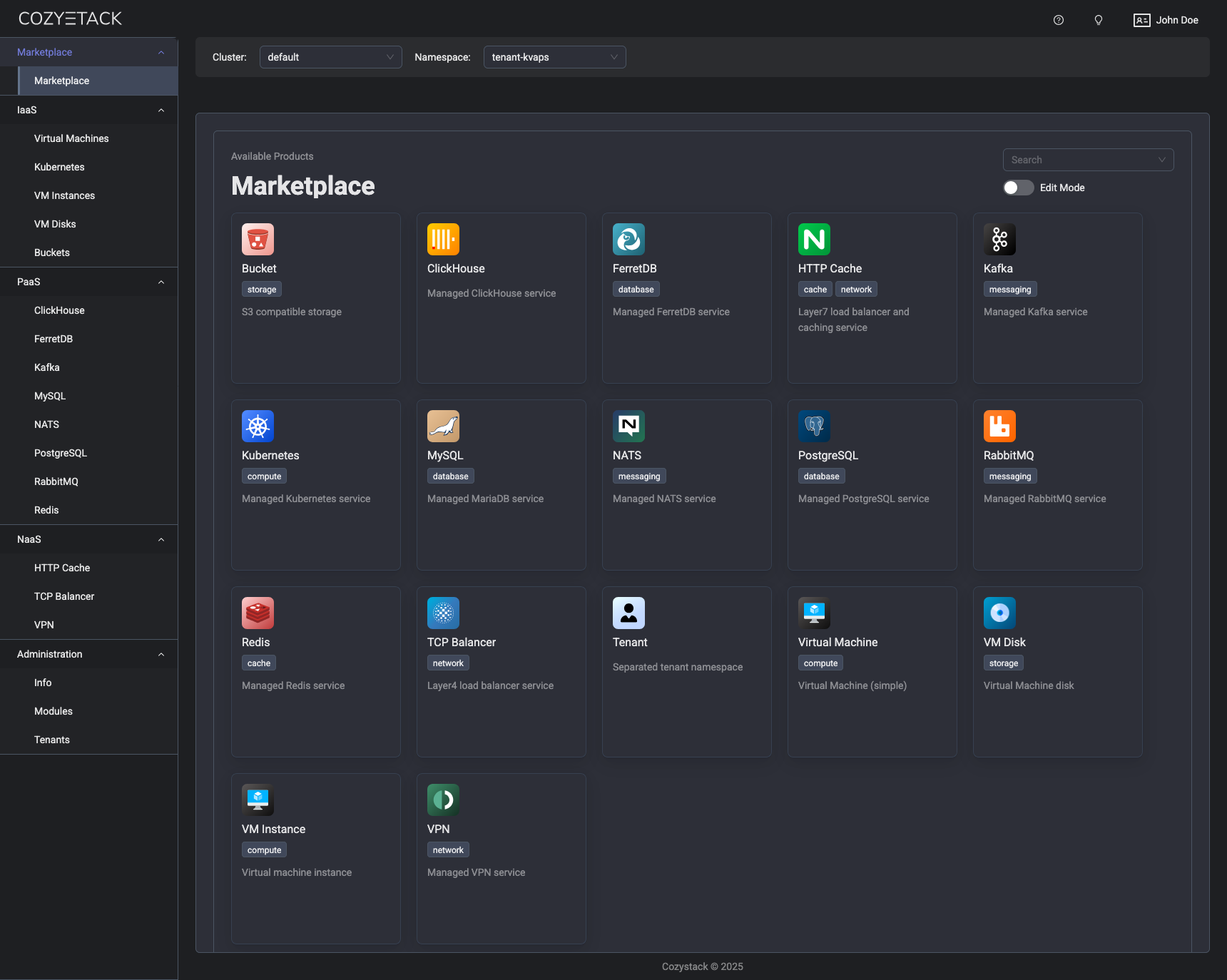
With Cozystack, you can transform a bunch of servers into an intelligent system with a simple REST API for spawning Kubernetes clusters, Database-as-a-Service, virtual machines, load balancers, HTTP caching services, and other services with ease.
Use Cozystack to build your own cloud or provide a cost-effective development environment.
Use-Cases
-
Using Cozystack to build a public cloud
You can use Cozystack as a backend for a public cloud -
Using Cozystack to build a private cloud
You can use Cozystack as a platform to build a private cloud powered by Infrastructure-as-Code approach -
Using Cozystack as a Kubernetes distribution
You can use Cozystack as a Kubernetes distribution for Bare Metal
Documentation
The documentation is located on the cozystack.io website.
Read the Getting Started section for a quick start.
If you encounter any difficulties, start with the troubleshooting guide and work your way through the process that we've outlined.
Versioning
Versioning adheres to the Semantic Versioning principles.
A full list of the available releases is available in the GitHub repository's Release section.
Contributions
Contributions are highly appreciated and very welcomed!
In case of bugs, please check if the issue has already been opened by checking the GitHub Issues section. If it isn't, you can open a new one. A detailed report will help us replicate it, assess it, and work on a fix.
You can express your intention to on the fix on your own. Commits are used to generate the changelog, and their author will be referenced in it.
If you have a concrete feature request, open an issue. For a cross-cutting or architectural change, open a design proposal in the community repo. For questions or early ideas, use GitHub Discussions. See CONTRIBUTING.md for the full routing.
Community
You are welcome to join our Telegram group and come to our weekly community meetings. Add them to your Google Calendar or iCal for convenience.
License
Cozystack is licensed under Apache 2.0.
The code is provided as-is with no warranties.
Commercial Support
A list of companies providing commercial support for this project can be found on official site.