 Andrei Kvapil
02c6942adc
## What this PR does

Closes the exposure behind GHSA-g883-q79m-8225 by constraining who can
reach the kube-ovn webhook's serving port. The `/mutate-pods` handler
returns namespace-derived annotations to any caller that reaches it, and
until now nothing stopped an arbitrary in-cluster pod from being that
caller.

### Why the client-certificate path does not close it

cozystack/cozystack#2698 added `--client-ca-file`, deliberately off by
default, as observation mode. Turning it on requires the API server to
**present** a certificate, which it does only when its
`AdmissionConfiguration` names a `kubeConfigFile` for the webhook
plugins.

Checked against a running Cozystack control plane rather than assumed:
the `AdmissionConfiguration` there carries a `PodSecurity` plugin block
and nothing else, so no client certificate is offered to admission
webhooks at all. Flipping to `RequireAndVerifyClientCert` on such a
cluster would reject the API server itself, and with `failurePolicy:
Fail` that stops pod creation cluster-wide.

This matters for how the remaining work was scoped: the plan had been to
observe issuer logs for a day and then pin a CA. No amount of
observation changes the outcome, because the absence is a property of
the control plane's configuration, not of the traffic. Making
`--client-ca-file` usable is a separate, larger change to how the
platform configures the API server, and it is not a prerequisite for
closing the exposure.

### What the policy does

Denies pod traffic and world traffic to the serving port, and needs no
carve-out for the legitimate caller: the API server runs on the host
network, so it is not a Cilium endpoint and `fromEndpoints` never
matches it. Unlike the ingress-nginx admission webhook this component
exists only on the management cluster, so there is no
konnectivity-tunnelled caller to exempt either — and consequently no
forgeable pod label anywhere in the selector.

It is a `CiliumNetworkPolicy` rather than a core `NetworkPolicy`, and
that distinction is the reason it works at all:
`packages/system/kubeovn/values.yaml` sets `ENABLE_NP: false`, so
kube-ovn programs no ACLs and a core NetworkPolicy would be created and
never enforced. The values comment that claimed NetworkPolicy was simply
not an option is corrected — it was true only of the core kind.
`webhookPolicy.enabled` lets a cluster whose networking variant ships no
Cilium turn the object off.

Deny-only with default-deny explicitly disabled, matching the
ingress-nginx admission policy: putting these pods behind a default-deny
would mean enumerating every port they serve and breaking traffic on the
first one forgotten.

### Verification

Eight helm-unittest cases cover the port, the all-namespaces span, the
absence of any label-based exemption, the world deny, the disabled
default-deny, the Cilium kind, the selector and the off switch. The
rendered object was additionally accepted by a live API server via
`kubectl apply --dry-run=server`, so the CRD validates it as written.

Not verified: that a denied pod actually fails to reach the port at
runtime. That needs a live negative test against the policy, which is
the same gap the ingress-nginx admission policy carries.

### Screenshots

Not applicable — no UI change.

### Downstream repositories

Walked the trigger map against the diff. Nothing is reached: the change
is one chart template, its values and its tests under
`packages/system/`, with no package added or removed under
`packages/apps/` or `packages/extra/`, no
`packages/core/platform/values.yaml` key, no platform variant or bundle
change, nothing under `hack/`, and no node prerequisite.

- [x] No downstream repository is affected by this change
- [ ] [cozystack/website](https://github.com/cozystack/website) -
follow-up:
- [ ]
[cozystack/terraform-provider-cozystack](https://github.com/cozystack/terraform-provider-cozystack)
- follow-up:
- [ ]
[cozystack/ansible-cozystack](https://github.com/cozystack/ansible-cozystack)
- follow-up:
- [ ] [cozystack/ccp](https://github.com/cozystack/ccp) - follow-up:
- [ ] [cozystack/talm](https://github.com/cozystack/talm) - follow-up:
- [ ] [cozystack/cozyhr](https://github.com/cozystack/cozyhr) -
follow-up:
- [ ] [cozystack/cozy-proxy](https://github.com/cozystack/cozy-proxy) -
follow-up:
- [ ]
[cozystack/cozystack-telemetry-server](https://github.com/cozystack/cozystack-telemetry-server)
- follow-up:
- [ ]
[cozystack/external-apps-example](https://github.com/cozystack/external-apps-example)
- follow-up:
- [ ] [cozystack/examples](https://github.com/cozystack/examples) -
follow-up:

### Release note

```release-note
fix(kubeovn-webhook): the kube-ovn webhook's serving port is now closed to in-cluster pods and external traffic by a CiliumNetworkPolicy. It previously answered any in-cluster pod with namespace-derived annotations (GHSA-g883-q79m-8225). Disable with webhookPolicy.enabled=false on clusters whose networking variant ships no Cilium.
```


<!-- This is an auto-generated comment: release notes by coderabbit.ai
-->
## Summary by CodeRabbit

* **New Features**
* Added a Cilium network policy to protect the namespace-annotation
webhook.
* The policy is enabled by default and restricts access to the webhook
port, blocking unauthorized in-cluster and external traffic.
* Standardized the webhook port across its deployment, service, and
network policy configuration.

* **Bug Fixes**
* Improved webhook network isolation when standard Kubernetes
NetworkPolicy enforcement is unavailable.
<!-- end of auto-generated comment: release notes by coderabbit.ai -->


Cozystack
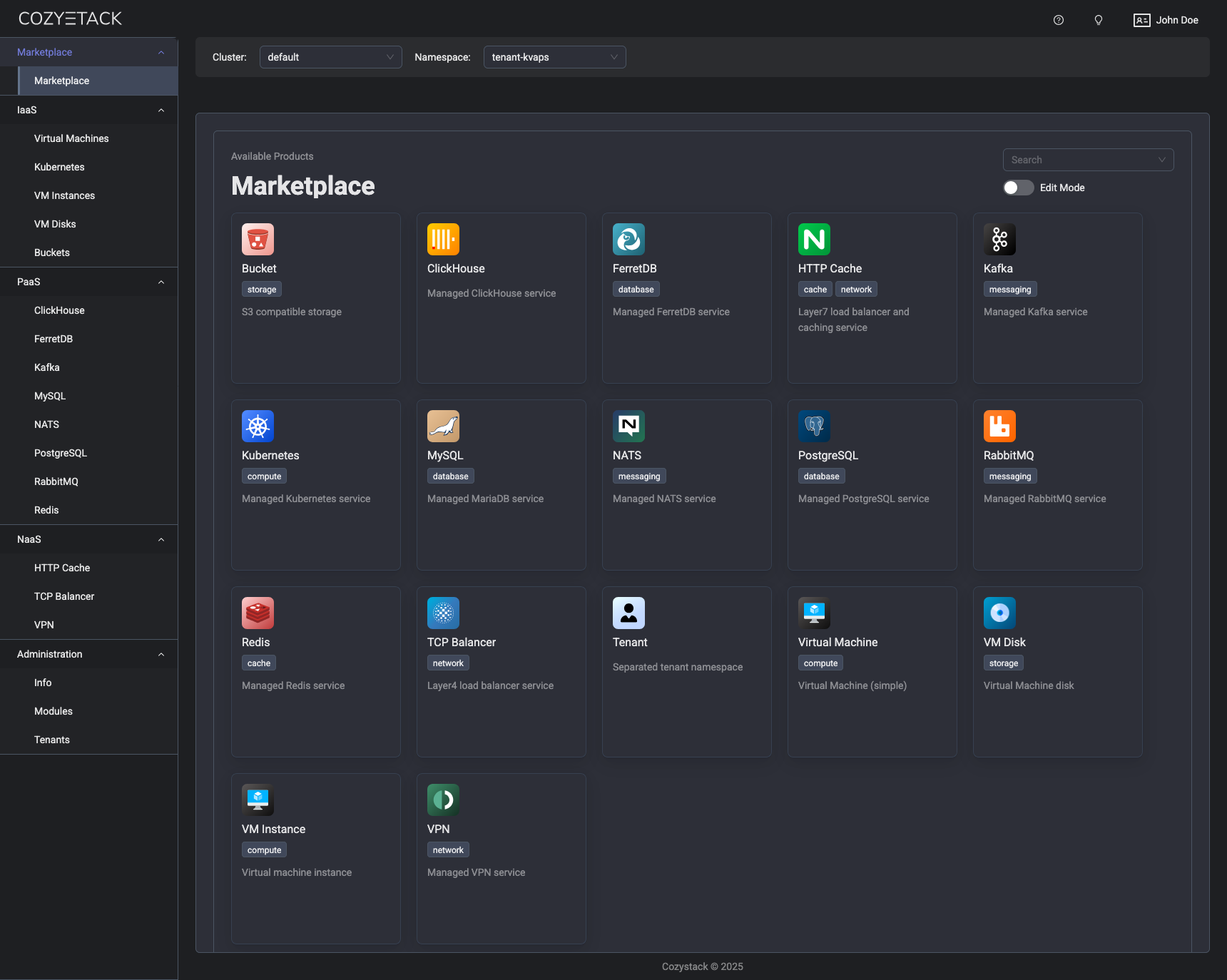
Cozystack is a free platform and framework for building clouds.
Cozystack is a CNCF Sandbox Level Project that was originally built and sponsored by Ænix.
With Cozystack, you can transform a bunch of servers into an intelligent system with a simple REST API for spawning Kubernetes clusters, Database-as-a-Service, virtual machines, load balancers, HTTP caching services, and other services with ease.
Use Cozystack to build your own cloud or provide a cost-effective development environment.
Use-Cases
-
Using Cozystack to build a public cloud
You can use Cozystack as a backend for a public cloud -
Using Cozystack to build a private cloud
You can use Cozystack as a platform to build a private cloud powered by Infrastructure-as-Code approach -
Using Cozystack as a Kubernetes distribution
You can use Cozystack as a Kubernetes distribution for Bare Metal
Documentation
The documentation is located on the cozystack.io website.
Read the Getting Started section for a quick start.
If you encounter any difficulties, start with the troubleshooting guide and work your way through the process that we've outlined.
Versioning
Versioning adheres to the Semantic Versioning principles.
A full list of the available releases is available in the GitHub repository's Release section.
Contributions
Contributions are highly appreciated and very welcomed!
In case of bugs, please check if the issue has already been opened by checking the GitHub Issues section. If it isn't, you can open a new one. A detailed report will help us replicate it, assess it, and work on a fix.
You can express your intention to on the fix on your own. Commits are used to generate the changelog, and their author will be referenced in it.
If you have a concrete feature request, open an issue. For a cross-cutting or architectural change, open a design proposal in the community repo. For questions or early ideas, use GitHub Discussions. See CONTRIBUTING.md for the full routing.
Community
You are welcome to join our Telegram group and come to our weekly community meetings. Add them to your Google Calendar or iCal for convenience.
License
Cozystack is licensed under Apache 2.0.
The code is provided as-is with no warranties.
Commercial Support
A list of companies providing commercial support for this project can be found on official site.