 Marian Koreniuk
5ab36023e0
Deleting a tenant cluster left its PVC disks on the hypervisor. The pre-delete
hook deletes every HelmRelease labelled with the cluster in Step 2, the CSI
driver among them, and nothing before that deleted the tenant's PVCs — a volume
is freed only by the driver answering DeleteVolume. capmox then destroys the
worker VMs, and Proxmox frees only what the destroyed VMID owns, which these
volumes are not. They stayed on storage with the tenant's data in them, and the
PV objects that could have named their owner went with the control plane.

Step 1b deletes the claims while the driver is still up, and it deletes the
claims before the Pods that hold them: a claim being deleted is one the
scheduler places no new Pod on, so a Pod that a StatefulSet or Deployment brings
back cannot mount it again and hold it to the backstop. The Pods go second: a
claim in use carries the kubernetes.io/pvc-protection finalizer, so it clears
only once nothing mounts it, and the Pods are going with the cluster in any
case. Then it waits for the PVs rather than the PVCs, because the claim
disappears as soon as its finalizer clears while the disk is freed only when the
PV is gone.

The Pods holding a claim are found by listing every Pod with the claims it
mounts and matching in the shell. A JSONPath filter on the claim name cannot do
it: with a Pod that mounts two claims its left side yields two values, client-go
refuses the whole expression ("can only compare one element at a time"), and no
Pod in that namespace would be found for any claim.

A kubeconfig that exists is not an apiserver that answers, and listing claims
against one that does not comes back empty — the clean case. Step 1b asks
/readyz first and sends an apiserver that stays silent through the backstop, so
the summary carries it. The probe is bounded by `timeout` rather than by
--request-timeout: a non-zero --request-timeout on an in-cluster kubectl call
diverts it to localhost:8080, which is why hack/check-hook-request-timeout.bats
refuses the flag in hook templates, and the check cannot tell this call, which
carries its own kubeconfig, from one that does not.

Best effort, and loud about it: a tenant that never came up has no apiserver to
ask, and a teardown must not wedge on that, but a timeout is reported through
the same backstop the other steps use.

The hook's Role gains one Secret by name — the tenant's admin kubeconfig, which
this step needs. Without it the step takes its no-kubeconfig branch and reports
that there is nothing to release while the volumes stay behind.

Step 5 no longer fails the whole hook where CDI is not installed. It deletes
DataVolumes, which are a KubeVirt-path component, and kubectl exits non-zero on
an unknown resource type; under set -e that failed the teardown after every
earlier step had already run, leaving the cluster half removed and the hook
reporting failure.

Verified on a throwaway tenant: a PVC bound and mounted by a running Pod, then
`helm uninstall`, and the volume freed by the driver rather than by hand.

delete_hook_test.yaml pins Step 1b and the Role's admin-kubeconfig entry on
proxmox and their absence on kubevirt, the /readyz probe, and the order of the
claim and Pod deletes.

Signed-off-by: Marian Koreniuk <moriarti@cp.if.ua>
Assisted-by: LLM




Cozystack
Cozystack is a free and open-source platform and framework for building clouds.
Cozystack is a CNCF Sandbox project that was originally built and sponsored by Ænix.
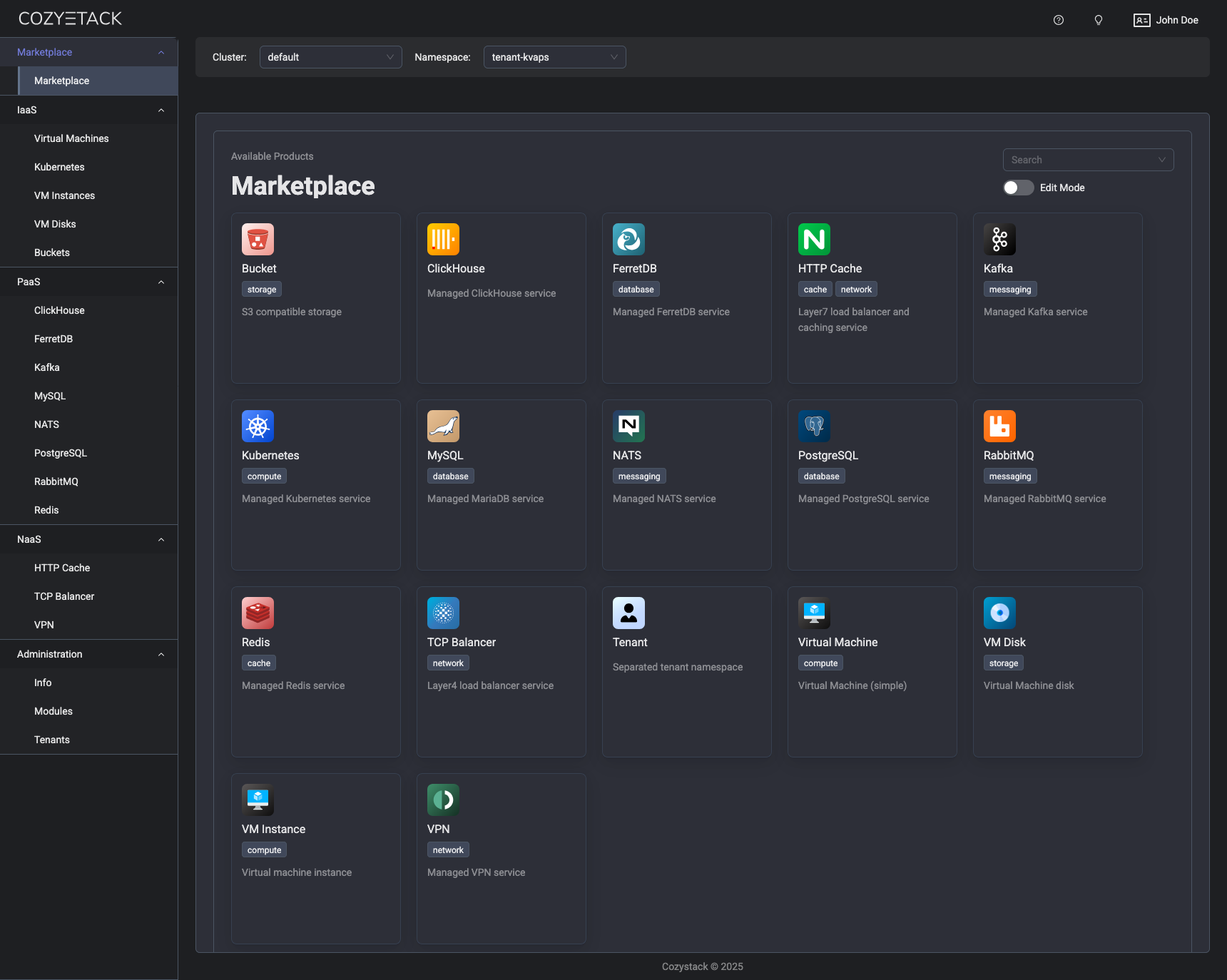
With Cozystack, you can transform a bunch of servers into an intelligent system with a simple REST API for spawning Kubernetes clusters, Database-as-a-Service, virtual machines, load balancers, HTTP caching services, and other services with ease.
Use Cozystack to build your own cloud or provide a cost-effective development environment.
Use-Cases
-
Using Cozystack to build a public cloud
You can use Cozystack as a backend for a public cloud -
Using Cozystack to build a private cloud
You can use Cozystack as a platform to build a private cloud powered by Infrastructure-as-Code approach -
Using Cozystack as a Kubernetes distribution
You can use Cozystack as a Kubernetes distribution for Bare Metal
Documentation
The documentation is located on the cozystack.io website.
Read the Getting Started section for a quick start.
If you encounter any difficulties, start with the troubleshooting guide and work your way through the process that we've outlined.
Versioning
Versioning adheres to the Semantic Versioning principles.
A full list of the available releases is available in the GitHub repository's Release section.
Contributions
Contributions are highly appreciated and very welcomed!
In case of bugs, please check if the issue has already been opened by checking the GitHub Issues section. If it isn't, you can open a new one. A detailed report will help us replicate it, assess it, and work on a fix.
You are welcome to take on the fix yourself. Commits are used to generate the changelog, and their author will be referenced in it.
If you have a concrete feature request, open an issue. For a cross-cutting or architectural change, open a design proposal in the community repo. For questions or early ideas, use GitHub Discussions. See CONTRIBUTING.md for the full routing.
Community
You are welcome to join us in #cozystack, on either CNCF Slack (get an invite) or Kubernetes Slack (get an invite), in our Telegram group, and at our community meetings. Add them to your Google Calendar or iCal for convenience.
Project documents
| Document | What it covers |
|---|---|
| Governance | How decisions are made and who makes them |
| Contributor Ladder | How to grow from contributor to maintainer |
| Maintainers | Who maintains the project |
| Code of Conduct | What we expect of each other |
| Security Policy | Reporting a vulnerability, and which releases get fixes |
| Adopters | Who runs Cozystack in production |
| Roadmap | Where the project is going |
License
Cozystack is licensed under Apache 2.0.
The code is provided as-is with no warranties.
Commercial Support
A list of companies providing commercial support for this project can be found on official site.